

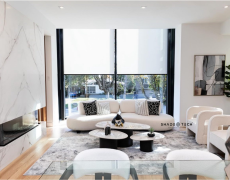
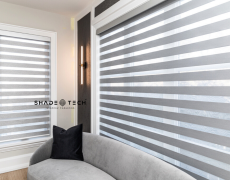
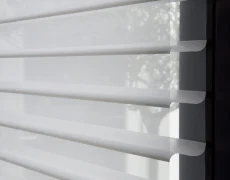
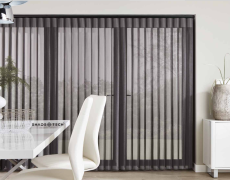
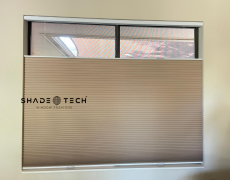

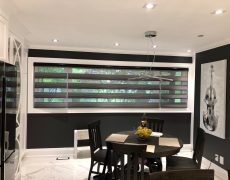
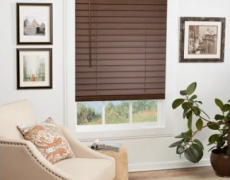
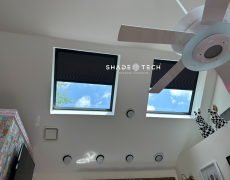


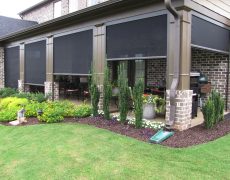

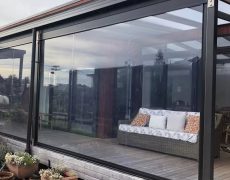



A west-facing Dallas living room can go from bright and inviting to uncomfortably hot in a matter of minutes. Smart blinds address that problem without asking you to walk from window to window each afternoon. So, how do smart blinds work? A compact motor moves the blind or shade on command, while a remote, wall control, app, voice assistant, or automation schedule tells it when to move.
The technology is straightforward, but a reliable result depends on much more than adding a motor to a window covering. The right fabric, precise sizing, power plan, control system, and professional setup determine whether a smart shade simply moves or actively improves comfort, privacy, and energy performance.
How Do Smart Blinds Work? The Core Components
Smart blinds and shades have four working parts: the window treatment itself, a motor, a power source, and a control method. The motor is typically concealed inside the headrail or roller tube, preserving the clean appearance of a custom treatment. When it receives a command, it turns the internal mechanism that raises, lowers, tilts, or rotates the louvers.
With motorized roller shades, the motor turns the roller tube to raise or lower the fabric. In motorized blinds, it may lift the blind, tilt slats, or do both. Motorized shutters use a different mechanism to rotate louvers with accuracy. The basic idea remains the same: electrical energy drives a motor, and the motor controls light at the window.
Most systems include adjustable upper and lower limits. These settings tell the shade exactly where to stop, preventing it from rolling too far and allowing preferred positions to be repeated. For example, a shade can stop halfway down to reduce afternoon glare while preserving the view, then close fully after sunset for privacy.
Motors are designed for quiet, controlled movement
Premium smart shade motors are engineered for low-noise operation and consistent positioning. The quality of the motor matters most on large, wide, or tall windows, where fabric weight and alignment place more demand on the system. A properly specified motor should move the treatment smoothly without pulling the fabric out of level or straining at the limits.
Speed is not always the priority. A slower, quieter motor can be preferable in bedrooms, media rooms, medical clinics, and hospitality settings. In a commercial space, dependability and repeatable scheduling often matter more than rapid movement.
Power can be battery, plug-in, or hardwired
Smart blinds need power, but the best source depends on the window, project scope, and access to electrical wiring. Battery-powered systems are popular for existing homes because they avoid opening walls. Rechargeable battery wands are typically hidden behind the shade or inside the headrail, though they will need periodic charging or replacement.
Plug-in motors work well when an outlet is nearby and the cord can be discreetly routed. Hardwired systems are often the strongest choice for new construction, major remodels, and large groups of shades. They eliminate battery maintenance and create a polished installation, but require coordination with an electrician before drywall and trim are complete.
Solar charging can extend battery life in suitable windows, but it is not a universal answer. The panel needs enough direct exposure, and its appearance may not suit every interior. In North Texas, strong sun can support solar charging, yet the same window may need a high-performance shade fabric to control heat and UV exposure.
How Smart Blinds Receive Commands
The motor does not need to be connected directly to your phone to be smart. It needs a communication method that connects it to a control device or automation platform. Depending on the system, that may be radio frequency control, Bluetooth, Wi-Fi, Zigbee, Z-Wave, Thread, or a dedicated smart-home bridge.
A handheld remote is often the simplest control option. It can operate one shade, a group of shades, or every treatment in a room. Wall-mounted controls offer the familiarity of a light switch, which is useful for guests, children, employees, and anyone who does not want to use an app.
App control adds scheduling and remote access. From a phone or tablet, homeowners can check a shade’s position, operate rooms individually, or create scenes such as Morning, Movie Time, or Away. A restaurant manager could close patio screens before a bright lunch rush. A clinic can set treatment-room shades to open before the first appointment and close automatically at the end of the day.
Voice control through Alexa, Google Home, or Apple HomeKit makes common commands convenient: “Close the family room shades” or “Open the kitchen blinds to 50 percent.” Matter-enabled systems can also simplify interoperability among compatible smart-home products. Compatibility should be confirmed before purchase, however. Not every motor, bridge, voice platform, and home network behaves the same way.
Automation Is Where Smart Shades Earn Their Place
Remote control is convenient. Automation is what turns motorized window treatments into a practical part of the home.
Schedules can follow the clock, opening bedrooms in the morning and closing sun-facing rooms before peak afternoon heat. Astronomical timers use local sunrise and sunset instead of a fixed hour, which is especially useful as daylight changes throughout the year. In Dallas-Fort Worth, a west-facing shade may need to lower well before sunset to reduce glare and solar heat gain.
Smart shades can also work within broader home routines. A “Good Night” scene can lower bedroom shades, close shutters, and dim lighting. An “Away” scene can position treatments to reduce visible interiors while allowing enough daylight to make the house look occupied. In media rooms, one command can lower blackout shades and adjust lighting for a better screen experience.
Some systems can use light sensors, temperature data, occupancy triggers, or smart-home logic. These features need thoughtful programming. A shade that closes whenever sunlight appears may be annoying in a breakfast room where the view matters. The better approach is to set rules by room, orientation, time of day, and how the space is actually used.
Smart Blinds Help Control More Than Light
The visible benefit is obvious: one touch can reduce glare. The performance benefits are more substantial when the treatment is selected for the window and climate.
Solar screen fabrics filter harsh daylight while preserving an outward view. They can help reduce glare on televisions and monitors, protect flooring and furnishings from UV exposure, and limit solar heat entering the room. Opacity matters. A more open weave offers better visibility outward but less privacy and less light control. A tighter weave provides stronger privacy and glare reduction, though it can soften the view.
Blackout shades are better for bedrooms, nurseries, and dedicated media spaces, but “blackout” fabric does not guarantee total darkness by itself. Light can still enter around the sides unless the installation includes appropriate side channels, fascia, or other light-management details. Precise measurement is what makes the difference between a shade that looks finished and one that leaves distracting light gaps.
For large contemporary windows, one oversized shade is not always the best answer. It may require a larger motor, heavier hardware, and a more visible headrail. Dividing the opening into multiple coordinated shades can improve operation, fabric alignment, and control flexibility. The right solution depends on the window’s width, height, exposure, and architectural details.
Installation Determines Long-Term Reliability
A smart blind is only as dependable as its mounting, measurements, and programming. Even a premium motor can struggle when brackets are not level, the fabric is sized incorrectly, or the headrail conflicts with window trim. On tall windows and high ceilings, access for charging, service, and future adjustments must also be planned before installation.
Professional measurement accounts for recess depth, molding, handles, obstructions, window squareness, and whether the treatment will mount inside or outside the opening. It also considers where power and control hardware will live. This level of planning is particularly valuable for builders and contractors coordinating electrical, drywall, millwork, and automated shading on the same project.
At ShadeoTech, local manufacturing and installation allow the product, measurements, and smart-home setup to be coordinated as one process. That reduces the common handoff problems that occur when window coverings, electrical work, and automation are sourced from separate providers.
Choosing the Right Smart Blind System
The best smart blind system is not necessarily the one with the most app features. It is the one that matches the room and remains easy to use every day. A battery-powered shade with a remote may be ideal for a single existing window. A hardwired, whole-home system may be the better investment for a new build with expansive glass and integrated lighting control.
Before selecting a system, consider the window’s sun exposure, the desired level of privacy, whether a view should remain visible, the availability of power, and the smart-home platform already in use. For commercial projects, add operational needs such as group control, staff access, durability, and consistent appearance across multiple rooms.
The most successful smart shade installations feel almost invisible. They lower before the room overheats, open when daylight is welcome, and fit the architecture so naturally that the technology becomes part of how the space works.
